EB-1A Petition Prep in 2026: Attorney, AI Platform, or DIY?
· 10 min read
By the Timeline of You team
The typical EB-1A petitioner spends $8,000 to $15,000 before they have a filed I-140. Most of that money goes to an immigration attorney, often before they have a clear sense of whether their profile is actually strong enough to win. This guide breaks down every path — honestly, with real numbers — so you can decide which option fits your situation before you spend anything.
There is no universally correct answer here. The right option depends on your profile strength, your budget, your risk tolerance, and how much you want to understand your own case. What follows is an honest comparison of four distinct approaches, including the tradeoffs most platforms don't advertise.
Traditional Immigration Attorney
Full-service legal representation
$8,000 – $20,000+
attorney fees only; add $715–$3,680 in USCIS fees
You hand your case to a licensed immigration attorney who drafts the petition letter, coaches your recommenders, organizes the exhibit package, and files on your behalf. If you get an RFE, they respond. They are legally accountable for the work product.
Examples: WeGreened, Manifest Law, Murthy Law, local boutique firms
Right for you if…
- Complex case history — prior denials, RFEs, visa status complications
- You want legal accountability if something goes wrong
- Your employer is paying (most common reason people go this route)
- Profile is borderline — you need someone experienced to frame the narrative
Watch out if…
- You don't know yet whether your profile is strong enough to file
- You're self-funding and $10K+ is prohibitive before knowing your odds
- You want to understand your own case, not just submit to a black box
- You assume hiring an attorney guarantees approval — EB-1A approval rates fell to ~53% in FY2025 even for attorney-filed cases
Reality check
Quality varies more than in most professional fields. EB-1A is a specialty inside immigration law, and a general immigration attorney with no track record in EB-1A is not meaningfully better than a strong DIY effort. Ask for EB-1A-specific case counts and approval rates before signing anything.
AI + Attorney Hybrid Platforms
Technology-assisted, attorney-backed
$5,000 – $12,000
flat-fee, typically includes RFE support; USCIS fees separate
These platforms wrap a licensed attorney around an AI drafting layer. The technology organizes your documents and generates an initial draft; the attorney reviews, edits, and files. The pitch is faster turnaround and lower cost than a traditional firm, with legal accountability preserved.
Examples: Alma ($10K), Passright, OpenSphere, Boundless, EB1A Experts
Right for you if…
- You want attorney-backed filing without Big Law billing rates
- Faster turnaround matters — some platforms promise 2–4 week filing windows
- You've already confirmed your profile is strong and want someone to execute
- Your case is fairly standard (researcher with citations, engineer with patents)
Watch out if…
- Pricing is often opaque until you book a sales call — "flat fee" can still mean $10K+
- The AI layer is mostly document organization, not strategic case analysis
- You still don't know your odds before committing thousands
- Some platforms' "AI" is marketing language for a form-fill workflow with a human at the end
Reality check
Alma is the most transparent in this category, publicly listing $10,000 for EB-1A. Others require a consultation before disclosing price. If you go this route, press them on EB-1A-specific approval rates — not overall rates that include simpler cases.
DIY Filing Platforms
Guided self-service, you file yourself
$299 – $950
platform fee; USCIS fees ($715–$3,680) additional; no legal coverage
Structured platforms that walk you through petition preparation step by step. You provide the evidence; the AI organizes it, maps it to criteria, and generates a draft petition letter and recommendation letter templates. You review, refine, and submit the I-140 yourself.
Examples: Quickfiling, eb1a.app, Deedy Das's guide + DIY
Right for you if…
- Strong, clearly documentable profile — you already know your criteria and have the evidence
- Budget-constrained, self-confident, and willing to invest significant time
- Academic or researcher profile where your publication record speaks for itself
- You've consulted a second opinion (free attorney eval or community review) and gotten positive signals
Watch out if…
- No RFE defense — if USCIS issues a Request for Evidence, you're on your own
- Strategic framing is on you — weakly argued evidence is still weak
- If your profile requires careful positioning (borderline criteria, nontraditional career path), a template won't save you
- Approval rate gap vs. attorney-filed: approximately 15–20 percentage points on comparable profiles
Reality check
DIY has worked well for people with clean, strong profiles who were willing to do serious research. Deedy Das's detailed EB-1A write-up on Medium documents exactly this. The risk is self-assessment bias — you may think your profile is strong when an experienced reviewer would see gaps you missed.
Self-Assessment First
Know your odds before spending anything
Free → $299
free assessment; optional $299 drafting pack
Before committing to any path, map your profile against all 10 USCIS criteria and get an honest read on where you stand. This category doesn't replace an attorney or a DIY platform — it answers the question every tool in the other three categories skips: "Should I even file, and if so, how strong is my case right now?"
Examples: Timeline of You, EB1A Experts LevelUp (basic), eb1ascore.com (quiz)
Right for you if…
- You're mid-career and genuinely unsure whether you meet the threshold
- You want to understand the Kazarian two-step before paying someone else to navigate it
- You're 6–18 months out from filing and want to know what to prioritize
- You've gotten conflicting signals — one attorney says strong, another says wait
Watch out if…
- If you already have a very strong, well-documented profile, you may not need the assessment layer — go straight to a DIY platform or hybrid service
- Not a substitute for legal advice if your case involves unusual complexity (prior immigration violations, unique visa status, etc.)
Reality check
The gap this fills is real: most people spend $500–$2,000 in attorney consultations just to answer "do I qualify?" before they've committed to filing. A self-assessment tool covers that ground faster, without the billing clock running.
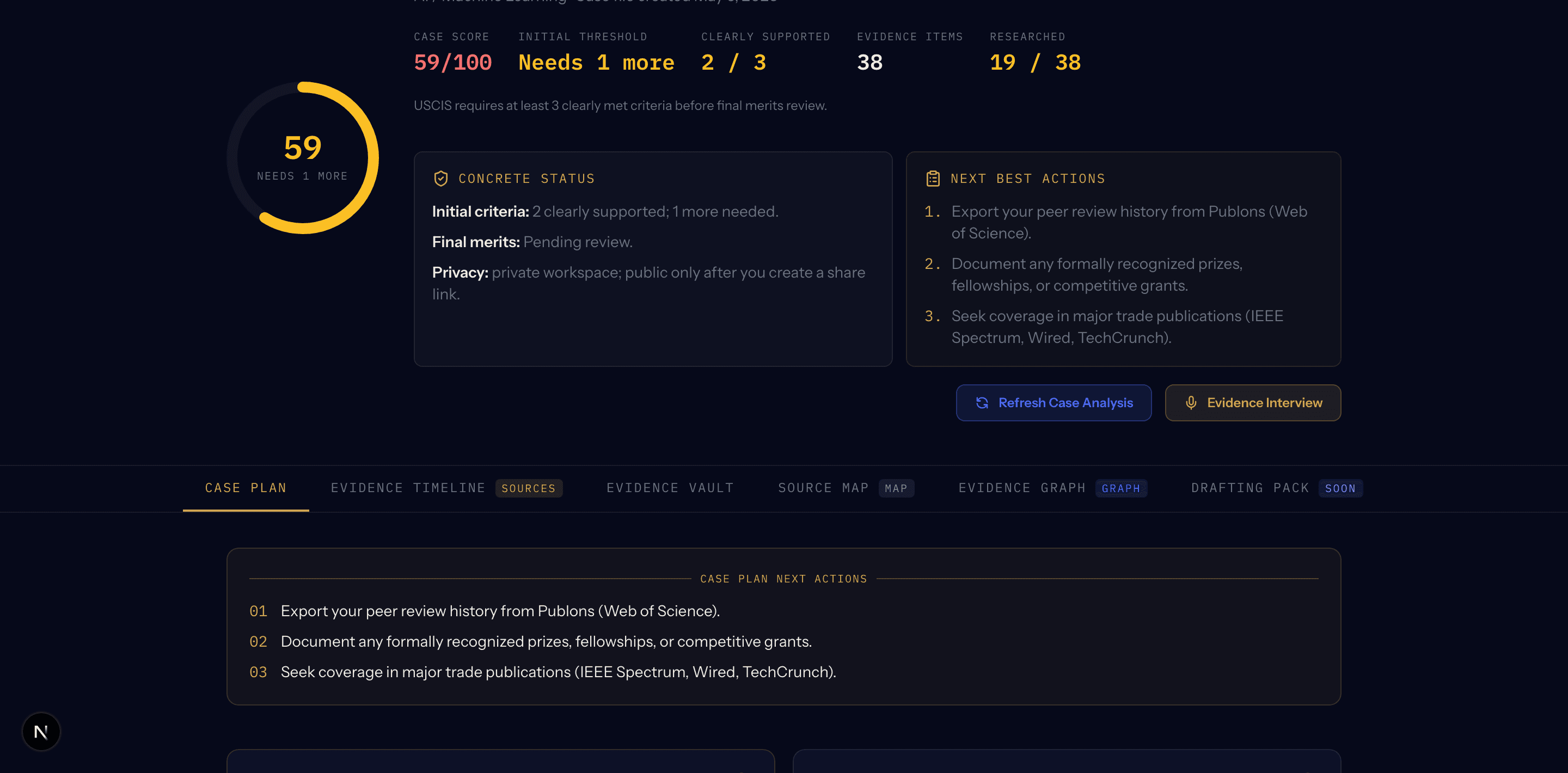
Timeline of You maps your evidence across all 10 USCIS criteria before you commit to any path or spend on legal fees.
Side-by-side comparison
The numbers below are based on publicly disclosed pricing, community data, and reported attorney fee ranges from r/immigration, Blind, and immigration law forums. Claimed approval rates from platforms are noted separately from independent data.
The step almost everyone skips
Almost no one in the list above tells you whether your profile is strong before you hire them. Attorneys do free 30-minute consultations, but those sessions are optimized for conversion, not diagnosis. Hybrid platforms route you to a sales call. DIY platforms assume you've already decided to file.
The question that should come first — do I actually have a strong case, and which criteria should I anchor on? — is largely unaddressed by any paid service. That gap is real. It's why so many people in immigration forums describe spending $500–$2,000 in consultation fees just to figure out whether EB-1A is worth pursuing at all.
The 10 USCIS EB-1A criteria are not self-explanatory. Whether your role at a company counts as "leading or critical" depends on the organization's standing in your field, how your role is documented, and whether you can show the role was essential rather than senior. Whether your papers clear "scholarly articles" depends on publication venue and how you frame the evidence relative to your subfield. Most petitioners don't know how to read their own profile through that lens.
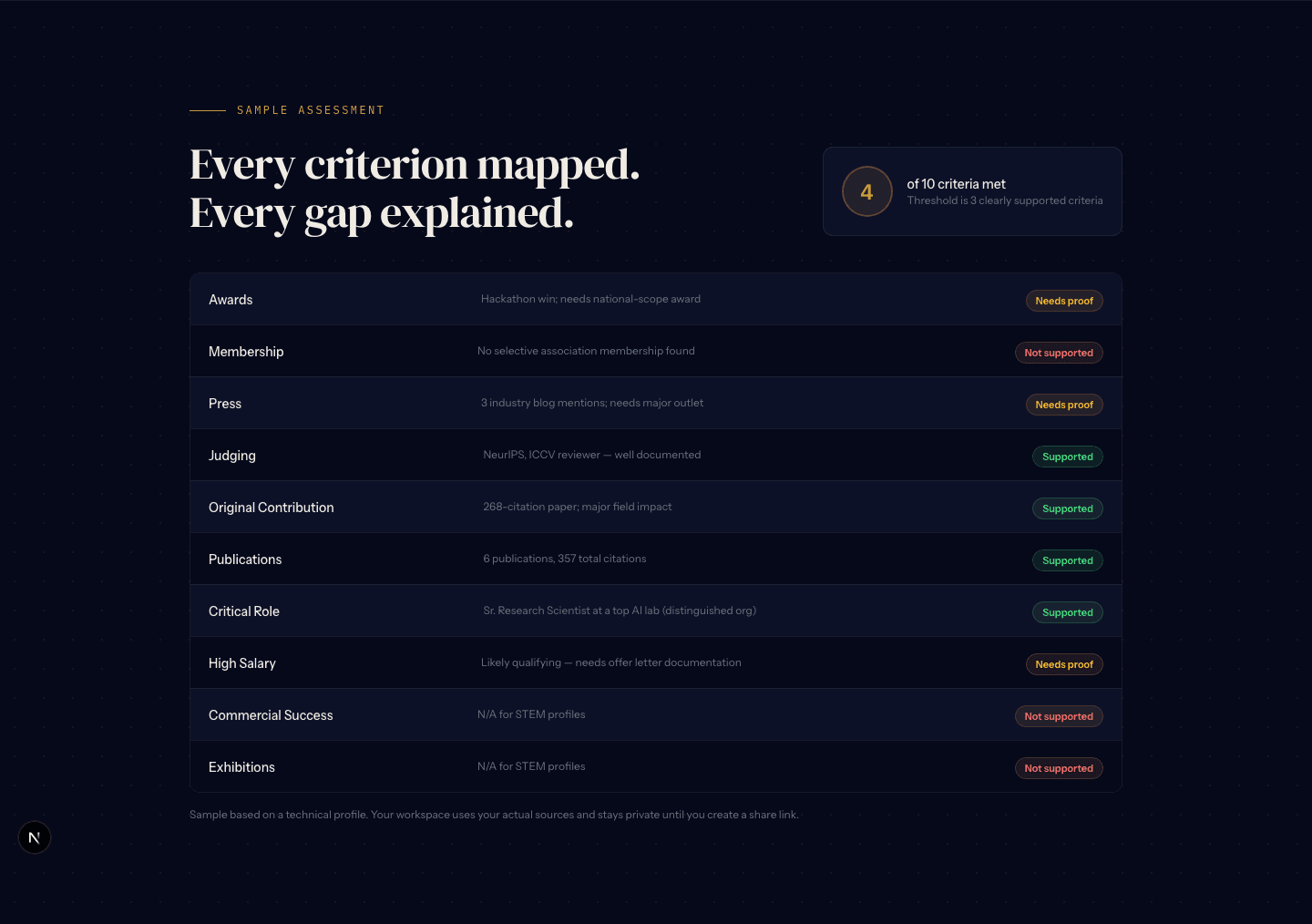
A criteria gap analysis shows exactly which evidence is strong, which needs work, and which criteria to drop from the petition entirely.
Decision guide: which path fits your situation
A note on approval rates
Every platform in this space has claimed approval rates between 90% and 99%. Treat these numbers with appropriate skepticism. They are self-reported, typically include only cases where the platform had sufficient evidence to build a strong petition, and the denominator (cases taken vs. cases filed vs. cases recommended for filing) is rarely disclosed.
USCIS public data tells a different story. EB-1A I-140 approval rates dropped from ~75% in FY2021 to approximately 53% in FY2025 as adjudication standards tightened under the Kazarian framework. That decline happened while every platform's marketing claims remained unchanged.
The right question isn't “what is your approval rate?” It's “what is your approval rate for profiles like mine, in my field, with my specific evidence profile?” Nobody can answer that without evaluating your case — which is exactly what a good self-assessment does before any money changes hands.
The bottom line
The best EB-1A outcome comes from knowing your case before you start spending. The tools and attorneys in options 01–03 are all legitimate paths — they just assume you've already made the decision to file, and they assume you have the right evidence. If either assumption is wrong, you are spending money to discover a problem that could have been caught for free.
Start with an honest assessment of your criteria. Know which three or four you can build the strongest case around. Know where the gaps are and whether they're fixable in your timeline. Then pick the service that matches your risk profile and budget.
The petition itself is downstream of the strategy. Get the strategy right first.
Before you choose a path
Run a free EB-1A eligibility assessment. See which criteria you meet, where your evidence is thin, and what a strong petition would look like from your actual profile — before you spend anything on attorneys or platforms.
Free assessment →