EB-1A for Tech Workers and AI Researchers: A Practical Guide
Last updated: May 13, 2026 · 10 min read
By the Timeline of You team · 10 min read
Most senior engineers hit the same moment: they're 8 years into their career, making $300K+ at a recognizable company, still on H-1B, and they finally look up the India EB-2 backlog. The number they see — 50+ years at current rates — doesn't compute at first. Then it does. Then someone mentions EB-1A, and they pull up the criteria and think “wait, I might actually have some of these.” This guide is for that moment. The EB-1A wasn't designed with software engineers in mind — the criteria were written for artists, athletes, and academics — but for senior engineers, ML researchers, and technical founders with the right career history, it's often achievable. Here's how to think through it honestly.
Why more tech workers are filing EB-1A
The EB-2 NIW is usually the first thing people look at — lower bar, no employer sponsorship required. The problem, if you're from India or China, is the backlog. It stretches decades. EB-1A has no per-country cap. A well-qualified engineer from India who would wait 80+ years for an EB-2 green card can get an EB-1A approved in 12–18 months.
The tradeoff is a higher evidentiary standard. But if you've been in the field for 8–10 years, published research, held senior roles at recognized companies, or built work that others depend on — you may be closer to qualifying than you think.
The 5 criteria most accessible to tech professionals
1. Judging the work of others
Usually the easiest criterion for anyone who has done peer review. Log into Publons (now part of Web of Science) and download your review history — that's your formal documentation. USCIS accepts peer review for recognized journals and conferences without much argument.
If you haven't done formal peer review: conference program committee work, grant review panels, or hackathon judging for nationally recognized events can work. Even open source maintainership — where you review and accept/reject contributions to a significant project — has been argued successfully here, though it requires more careful framing.
2. Scholarly articles
Strongest for ML and AI researchers. What matters is venue prestige and citation impact, not volume. Three papers at NeurIPS, ICML, or ICLR outweigh fifteen workshop papers. If you have Google Scholar citations, pull the full export. OpenAlex fills in institution-level data on who's citing your work.
Citation count benchmarks for EB-1A
There's no official USCIS threshold, but practitioner experience suggests: 100+ total citations is workable, 500+ is strong, 1,000+ is compelling. What matters more than the count is whether the citations are from independent researchers at different institutions — not self-citations or lab group citations.
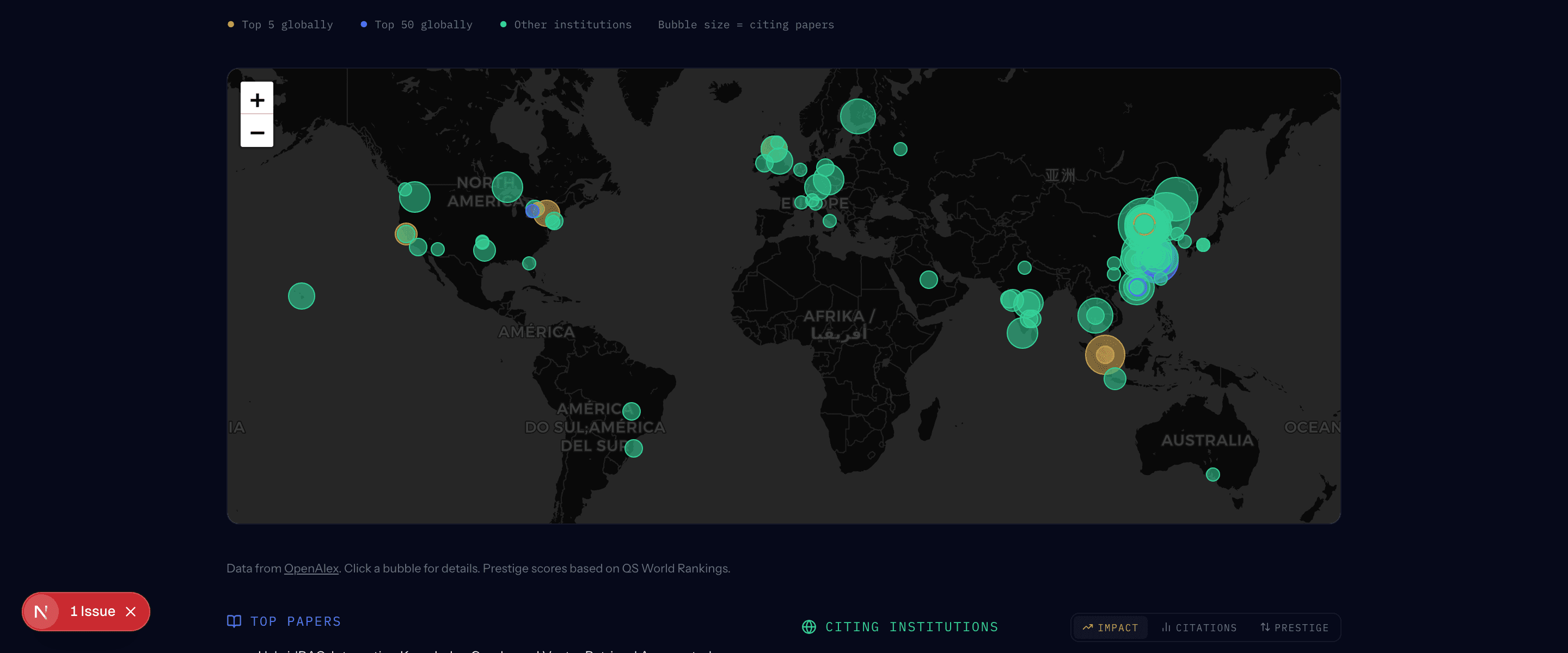
Citation network auto-built from OpenAlex — shows global reach of research across institutions and countries
3. Original contribution of major significance
Where senior engineers without academic publications can make their strongest case. A widely-adopted open source project — millions of downloads, deployed at recognizable companies — qualifies here. So does a patent that's been licensed. Papers with 100+ citations demonstrating field-level influence. The key phrase USCIS uses is “major significance” — you need documented evidence that others built on your work, not just that you built something interesting.
Letters from recognized peers explaining the significance of your contributions carry real weight here. A professor or industry leader who can speak to why your work mattered to the field is stronger than a citation count alone.
4. Critical or essential role in distinguished organizations
Senior or specialized roles at companies recognized as distinguished in AI/ML or tech: Google, Microsoft, Meta AI, Apple, OpenAI, Anthropic, DeepMind. The role has to be senior, specialized, or leadership — not just that you work there. Staff Engineer, Principal Scientist, Distinguished Engineer, or Technical Lead of a flagship product. A generic SWE II at a FAANG is a harder argument, even if the company clearly qualifies.
For founders: CTO or technical co-founder of a funded startup can qualify if the company has achieved meaningful recognition — press coverage, notable funding, significant adoption metrics. Early-stage with no track record is difficult.
5. High salary
Total comp — base, bonus, equity — in the top 10–15% for your occupation and metro. The documentation requirements are specific: you need an offer letter or pay stub (not an estimate), paired with BLS OES data for your SOC code and location. Levels.fyi can supplement but won't substitute. In Bay Area tech, senior roles often clear this bar without much effort.
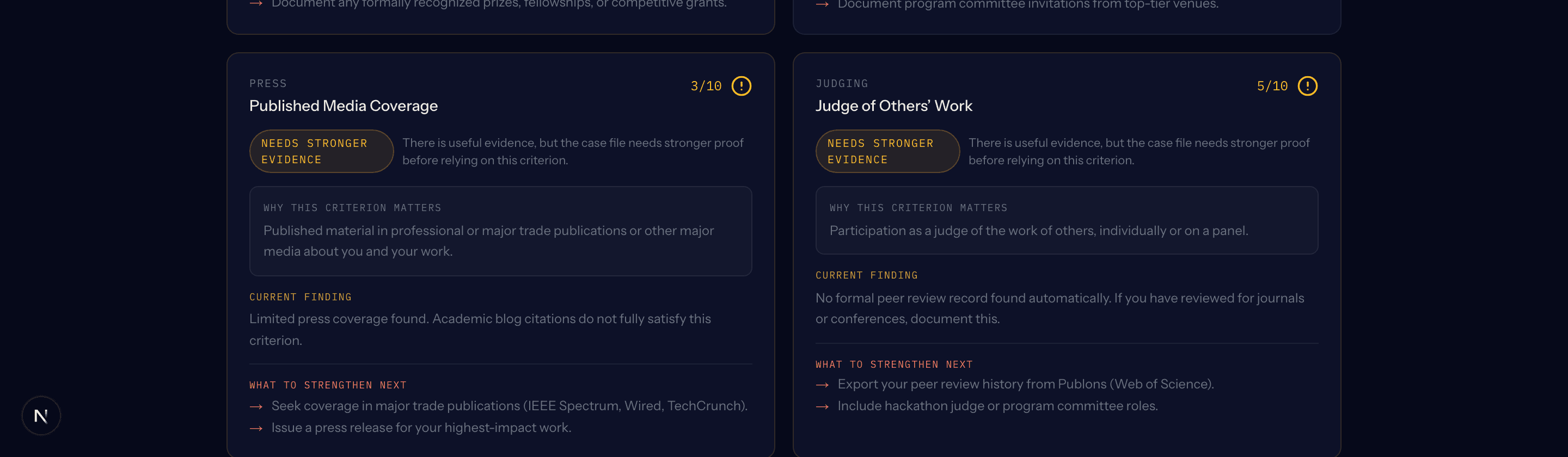
Each criterion assessed individually — current findings, evidence gaps, and exactly what to gather next
Criteria that are harder to build retroactively
Awards and prizes. Internal company awards don't count. Named competitive awards judged by external peers do — best paper at a major ML conference, NSF GRFP, Hertz Fellowship, MIT TR35, Forbes 30 Under 30, ACM prizes. If you don't have any of these, applying for IEEE Senior Member takes 6–12 months and is worth pursuing while you build the rest of your case. You can't manufacture a best paper award after the fact.
Press coverage. Has to be about you specifically, in major trade or general-interest media. A feature in Wired, TechCrunch, or MIT Technology Review counts. Your company's press release doesn't, and neither does a mention in a roundup. A PR firm reaching out to journalists can sometimes get a profile placed — but that takes 3–6 months of active pursuit.
Mistakes that lead to RFEs
Claiming peer review without documentation. “I review papers for journals” is not evidence. A Publons printout or invitation letter is. Get it first, claim it second.
Conflating seniority with distinction. A Senior Engineer title doesn't make you extraordinary in your field. Your role needs to be documented as having significant impact — through org charts, scope descriptions, and letters from leadership, not just the title itself.
Overly narrow field definition. “Transformer-based attention mechanisms for vision-language models in medical imaging” is too specific to establish top-of-field status. “Machine learning” or “computer vision” work better.
All evidence from one employer. If everything you're submitting originated at your current company — letters from your boss, company press releases, internal awards — an officer will question whether your reputation extends anywhere else. External peer recognition matters.
Building your case when you're not there yet
Many tech workers are 60–70% of the way to a strong EB-1A case but have specific gaps. The good news: most gaps are closable if you have 6+ months and know what to target.
If you're missing judging: Apply to review for ICLR, NeurIPS, or ICML workshops. The response rate is decent if you have relevant publications — conference organizers are always looking for qualified reviewers. Takes 2–3 months to build a documented review record. If you don't have publications, look at grant review panels (NIH, NSF, DARPA all use external reviewers) or program committee roles at smaller but recognized venues in your specific domain.
If you're missing press coverage: A TLDR Newsletter writeup, a popular tweet thread about your work, a Hacker News post reaching #1 — these don't count. But a Wired interview, an IEEE Spectrum feature, or a TechCrunch article about your company where you're named as the technical architect can. The distinction is editorial coverage in recognized outlets, not social media reach. PR firms specializing in tech researchers charge $3k–8k/month; some attorneys bundle press outreach as part of their preparation service. If you go this route, start 6+ months before filing.
If you're missing original contribution impact: You can't control citations, but you can influence them. Send your work to researchers who might cite it. Present at workshops. Write accessible explainers that make your methods easier to build on. More practically: if you've open-sourced something significant, a README with deployment stats — Fortune 500 companies using it, total downloads, named adopters — is legitimate evidence of major significance. GitHub star counts alone don't move the needle, but documented enterprise adoption does.
If you have 6+ months before filing: The IEEE Senior Member application is worth doing. It takes roughly 6 months, has solid approval rates for people with peer-reviewed publications and 10+ years of professional experience, and gives you a named, externally-granted recognition from a major professional society. It's not a slam-dunk criterion on its own, but it strengthens the overall picture of peer recognition — especially useful if you're light on awards.
Starting point
The right first step is an honest inventory across all 10 criteria — not a gut check, but a documented accounting of what you actually have. Which criteria can you satisfy with strong evidence? Which are borderline? Which are missing entirely? That tells you whether to file now, spend 6 months building specific evidence gaps, or consider a different path.
Evidence inventory
Week 1–2
Document every criterion against actual evidence you have
Gap assessment
Week 2–4
Identify which criteria are strong, borderline, or missing
Gap-closing
Month 1–6
Peer review, IEEE membership, press outreach if needed
Expert letters
Month 3–5
Identify and approach letter writers; allow 4–6 weeks for drafts
Petition prep
Month 4–6
Cover letter, exhibit organization, supporting documentation
Filing
Month 6+
Submit I-140; consider premium processing ($2,805 for 15 business days)
Map your tech career against EB-1A criteria
Free assessment analyzes your publications, role, citations, and salary against all 10 EB-1A criteria — with specific gap explanations and next steps.
Get my free EB-1A assessment →EB-1A Strategy Guide
Get notified when we publish new guides
Practical EB-1A strategy for researchers, engineers, and founders. No spam.
Related Guides
Do I Qualify for EB-1A? The Honest Eligibility Checklist
Most people are wrong about their EB-1A chances — in both directions. Here's the concrete checklist USCIS actually uses.
8 min →
EB-1A for Indian Nationals: The No-Country-Cap Advantage
The EB-2 backlog for India stretches 195+ years. EB-1A has no per-country cap and is currently current. Here is what that actually means.
8 min →
EB-1A vs NIW: Which Green Card Route Is Right for You?
Both paths skip employer sponsorship. Here's how to decide which fits your profile — and why some people file both.
9 min →