EB-1A vs NIW: Which Green Card Route Is Right for You?
Last updated: May 12, 2026 · 9 min read
By the Timeline of You team · 9 min read
Both EB-1A and NIW (National Interest Waiver, EB-2) let you self-petition — no employer sponsorship, no PERM labor certification. That's the main thing they have in common. Beyond that, they serve different profiles and have meaningfully different approval standards.
The core difference
NIW asks: does your work benefit the United States in a substantial way, and is the national interest better served by waiving the normal sponsorship requirement? EB-1A asks: are you among the small percentage of people who have risen to the very top of their field?
NIW is forward-looking and somewhat discretionary. EB-1A is backward-looking and evidence-heavy. With NIW, you're arguing that your work matters to the country. With EB-1A, you're arguing that your career record places you at the top of your profession — and proving it with documentation.
Here's how the same person frames their work differently for each petition. Say you're a senior ML engineer who built a real-time anomaly detection system deployed across a major hospital network. For NIW, the argument centers on national importance: your work improves healthcare outcomes for millions of Americans, reduces costs, and advances a STEM field with clear public benefit. You point to the downstream impact. For EB-1A, that framing is mostly irrelevant. Instead, you argue that you're at the top of the ML field: your papers on the underlying methods have 400+ citations from independent researchers across 30 institutions, you reviewed for NeurIPS, and your salary places you in the top 10% nationally for your occupation. Same person. Same career. Completely different argument.
When NIW makes more sense
NIW is generally the right starting point if you're earlier in your career, working in a field with clear national interest alignment (biomedical research, clean energy, national security, public health), or don't yet have the external peer recognition that EB-1A requires.
The Dhanasar standard — the framework USCIS uses for NIW since 2016 — requires three things: your proposed endeavor has substantial merit and national importance, you're well-positioned to advance it, and waiving the job offer requirement serves the national interest. For a PhD-level researcher or specialized professional, this is achievable without the extraordinary achievement threshold of EB-1A.
NIW also has more flexibility in how you frame your work. Future plans and ongoing research count — you're not limited to past accomplishments.
When EB-1A makes more sense
EB-1A is in the EB-1 preference category, which has no backlog for any country right now. NIW is EB-2, which has a decades-long queue for Indian and Chinese nationals. If you're from one of those countries and can credibly make the EB-1A case, the priority date difference alone makes it worth pursuing — potentially decades faster.
EB-1A also doesn't require you to frame your work as specifically benefiting the United States. If your research or career is international in scope, or doesn't map neatly onto national interest language, EB-1A may actually be easier to argue.
The tradeoff: EB-1A requires documented extraordinary achievement across multiple USCIS criteria. You need 3 of 10. And the evidence has to be real — external peer recognition, not just internal career progression.
Who should be taking EB-1A seriously? The 8-year NVIDIA engineer who's a principal scientist on GPU architecture, has patents in production, and reviews for IEEE conferences. The Stanford ML PhD with 500 Google Scholar citations, a NeurIPS paper that got 300 citations in two years, and a high salary offer. The startup CTO whose company raised a $40M Series B, appeared in TechCrunch, and has a product deployed at Fortune 500 companies. None of these people are household names. They're accomplished senior professionals — which is exactly what EB-1A is designed for, despite what the “extraordinary ability” label implies.
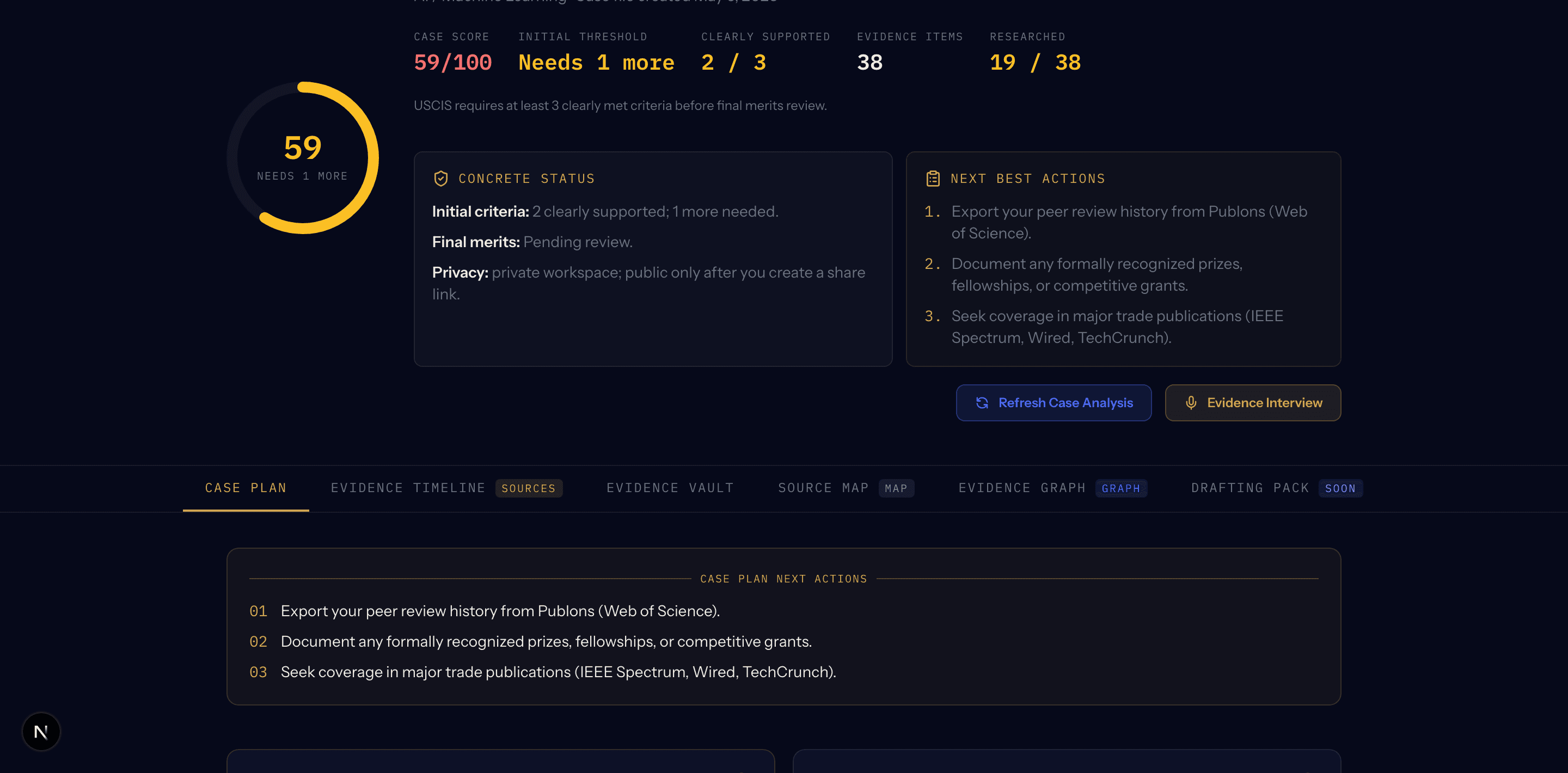
Understanding which criteria you currently meet is the first step — for both EB-1A and NIW strategy
Can you file both?
Yes, and many people do. Filing I-140 petitions for both EB-1A and NIW simultaneously is legal. They're independent petitions evaluated separately. If your EB-1A gets denied but NIW gets approved, you're still in the queue — just in EB-2 instead of EB-1. For non-India/China nationals where the backlogs are similar, this is less relevant. For Indian nationals in particular, dual filing makes sense if you're on the fence about EB-1A eligibility: the filing fees are a few thousand dollars, and the potential upside of landing in EB-1 is enormous.
The dual-filing math
The I-140 filing fee is $715. Attorney prep for a single petition typically runs $3,000–$6,000, depending on complexity and firm. Filing both EB-1A and NIW simultaneously might cost $8,000–$14,000 total. That sounds like a lot until you price the alternative.
For an Indian national currently in H-1B status, the expected value calculation is pretty obvious. If EB-1A succeeds, you skip the EB-2 India queue entirely — which is currently retrogressed so far that applicants filing today may not see a visa number for 50+ years under current rates. The financial upside of escaping employer-sponsored status even 5 years earlier is measured in hundreds of thousands of dollars of career optionality. The cost of the extra petition is noise.
The only scenario where dual filing doesn't pencil out: you're clearly not EB-1A eligible (early career, minimal peer recognition, no meaningful criteria), in which case spending money on a long-shot EB-1A petition is just waste. But if you're genuinely on the border — think you can satisfy 2–3 criteria with decent documentation — file both. The NIW is your insurance policy.
What immigration attorneys actually recommend
USCIS won't tell you this, but experienced immigration practitioners have a pretty consistent view on this question: if you're an Indian or Chinese tech worker with 8+ years of career history and some form of external peer recognition, evaluate EB-1A seriously before defaulting to NIW. The instinct to file NIW — because the bar feels lower and the framing feels easier — is understandable. But for this specific population, it's often the wrong call.
The practitioner consensus isn't “EB-1A is always better.” It's “don't assume NIW is your only option without actually checking.” Many attorneys report that clients who come in certain they only qualify for NIW turn out to have solid EB-1A cases once the evidence is properly inventoried. The reverse is also true — people who think they're obvious EB-1A candidates sometimes have weaker cases than they realize. The point is: assess first, choose second.
Timeline difference in practice
The abstract version: EB-1A has no per-country backlog; NIW for India-born filers has a multi-decade wait. Here's what that means concretely.
A 35-year-old Indian engineer files an NIW today. The India EB-2 priority date cutoff as of early 2026 is roughly 2012 — meaning people who filed 13+ years ago still haven't received visa numbers. At the current pace of advancement, someone filing in 2026 might see a visa number sometime in the 2050s. That engineer would be in their 60s or 70s before their NIW actually becomes actionable. Their entire working career passes under H-1B dependency: can't change jobs without sponsorship, can't start a company easily, can't negotiate from a position of optionality.
The same engineer files EB-1A today. If approved — typically 6–8 months with premium processing — they're in the EB-1 queue with current priority dates. Green card in hand by age 37, realistically. That's not a marginal improvement. That's a different life.
NIW reform and what's changing
NIW has quietly gotten harder since the 2016 Dhanasar decision replaced the older Rusin standard. The new framework was supposed to be more flexible — and it is, in some ways — but it also gave officers more latitude to scrutinize “national importance” claims that used to sail through. USCIS has applied increasing skepticism to tech and STEM NIW petitions that rely on vague future impact claims without concrete evidence of national-level significance.
STEM fields still get deference under the 2022 policy update, but that deference isn't unlimited. Officers look harder at whether the “national importance” framing is specific and documented, or just boilerplate about how technology benefits society. Meanwhile, EB-1A approval rates have remained stable — hovering around 70–74% in recent years — because the criteria are more objective. Either you have peer review documentation or you don't. Either the salary data shows top 10% or it doesn't.
The practical implication: NIW isn't a “safe” fallback the way it was five years ago. If you're going to invest in a petition either way, invest in one that's built on actual documented evidence — which EB-1A is designed around.
Common mistakes when choosing
Filing NIW when EB-1A is available. The most common and costly mistake for Indian and Chinese tech workers. The assumption is “NIW is easier so I'll start there.” But “easier to file” and “better outcome” are completely different things. If you qualify for EB-1A and file NIW instead, you've just sentenced yourself to a decades-long backlog when you didn't have to.
Filing EB-1A without a real evidence inventory. The opposite mistake: assuming your senior title and good salary are enough without checking what you can actually document. EB-1A officers are looking for external peer recognition — not internal career success. If all your evidence comes from your own employer, expect an RFE.
Not filing NIW as a backup. If you're genuinely uncertain about EB-1A, file both. The cost of a second I-140 is trivial relative to the downside of EB-1A denial with no backup in the queue.
Waiting to “get more credentials” before filing. The honest answer here is: most people who wait for “one more paper” or “one more year of experience” are procrastinating. If you currently meet 3 criteria with solid documentation, file now. You can file again later if your profile strengthens. The priority date you establish today is the one that matters.
Running your profile against EB-1A criteria takes 3 minutes and tells you which path is actually viable
Quick decision guide
From India or China?
Strongly consider EB-1A — the EB-1 backlog is currently zero vs. decades for EB-2.
8+ years of career with external peer recognition?
EB-1A is worth a serious look.
Early career or academic researcher?
NIW is usually the easier path first.
Work in biomedical, clean energy, or national security?
NIW language maps naturally to your field.
Can you satisfy 3 EB-1A criteria with real documentation?
File EB-1A. Consider NIW as backup if on the border.
On the fence about EB-1A eligibility?
File both simultaneously. The dual filing cost is worth the insurance.
The honest answer
If you're a senior tech worker or researcher from India and you have 3 solid EB-1A criteria with documentation — file EB-1A. The wait time difference justifies almost any additional preparation cost. If you're not sure whether your criteria hold up, get a concrete assessment first. “Maybe I qualify” is not a strategy.
Not sure which path fits your profile?
Free assessment maps your background against EB-1A criteria specifically — with a readiness score and gap analysis so you can make the call with actual data.
Get my free EB-1A assessment →EB-1A Strategy Guide
Get notified when we publish new guides
Practical EB-1A strategy for researchers, engineers, and founders. No spam.
Related Guides
EB-1A for Indian Nationals: The No-Country-Cap Advantage
The EB-2 backlog for India stretches 195+ years. EB-1A has no per-country cap and is currently current. Here is what that actually means.
8 min →
EB-1A for Tech Workers and AI Researchers: A Practical Guide
How engineers, ML researchers, and technical leads can build a compelling EB-1A case — which criteria map best to a tech career.
10 min →
Do I Qualify for EB-1A? The Honest Eligibility Checklist
Most people are wrong about their EB-1A chances — in both directions. Here's the concrete checklist USCIS actually uses.
8 min →